Best Practices for Iterative Cold Email Campaigns
Best Practices for Iterative Cold Email Campaigns
Cold email campaigns can deliver impressive results, but success lies in constant testing and optimization. Instead of settling for a 5% response rate, teams can achieve up to 20% by refining strategies through A/B testing, personalization, and data-driven adjustments. Here’s a quick breakdown of the key takeaways:
- Start with Deliverability: Ensure emails land in inboxes by setting up SPF, DKIM, and DMARC. Warm up domains gradually and monitor metrics like bounce rates (<3%) and open rates (>60%).
- Segment Your Audience: Create targeted lists based on industry, company size, and job roles. Segmented campaigns see 14% higher open rates and 75% more clicks.
- Test and Refine Emails: Use A/B testing to optimize subject lines, content, and send times. Keep emails short (50–125 words) and personalized for better engagement.
- Follow Up Strategically: 55% of replies come from follow-ups. Use a structured sequence (2–3 days apart) and avoid generic reminders.
- Leverage Tools Like ColdStack.so: Integrate Slack-based tools for real-time tracking, collaboration, and faster responses.
- Track Metrics: Monitor open rates, reply rates, and conversion metrics to identify weak spots and improve campaigns.
- Scale Carefully: Use multiple domains and mailboxes to expand outreach without harming your sender reputation.
Cold email can generate $36 for every $1 spent when executed with precision. The key is to test, track, and adjust continuously.
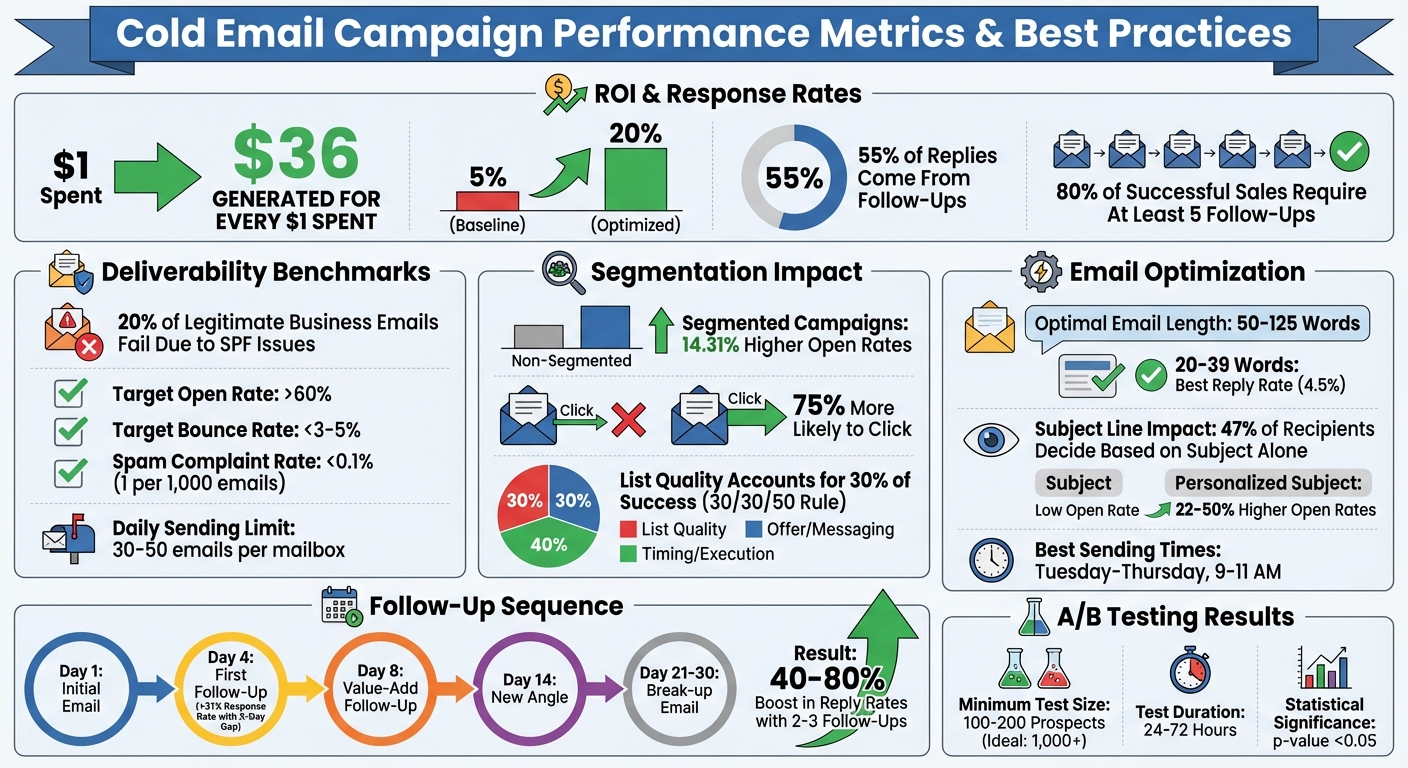
Cold Email Campaign Performance Metrics and Best Practices
How To A/B Test Angles In A Cold Email Campaign
1. Set Up Strong Email Deliverability Foundations
Before diving into subject line experiments or refining your email content, make sure your emails are actually reaching inboxes. Here's a startling fact: nearly 20% of legitimate business emails never make it to their destination due to SPF authentication failures. That’s one out of every five emails vanishing before anyone even gets a chance to read them. The first step to fixing this is setting up proper domain authentication.
Start by configuring your DNS with three key protocols: SPF (Sender Policy Framework), DKIM (DomainKeys Identified Mail), and DMARC (Domain-based Message Authentication, Reporting, and Conformance). These protocols act as your "proof of identity", showing email providers that your messages are legitimate and not spoofed. Without them, your emails are more likely to land in spam folders.
Next, focus on protecting your sending reputation, especially if you’re using a new domain. Use a domain warm-up strategy: send only 2–15 emails per day at first, and gradually increase the volume over a two-week period. Sending hundreds of emails from an untested domain can trigger spam filters almost instantly. Once warmed up, aim to send no more than 30 emails per inbox per day to maintain trust with email service providers.
It’s also crucial to keep an eye on your reputation. Use tools like Sender Score to monitor performance and detect potential issues early. To stay in good standing, maintain open rates above 60% and keep bounce rates under 3–5%. Verifying email addresses before you send can help you hit these benchmarks.
Finally, steer clear of links and attachments in your initial outreach emails. These are red flags for spam filters and can derail your efforts before you even start. Instead, stick to plain text and focus on starting a conversation. Once your deliverability is solid, you’ll be in a strong position to test and optimize your email campaigns.
2. Build Targeted Prospect Lists and Create Test Segments
Once you've ensured your emails are deliverable, it’s time to focus on building prospect lists that drive results. Why? Because segmented email campaigns consistently outperform non-segmented ones - research shows they achieve a 14.31% higher open rate and make recipients 75% more likely to click. The secret lies in relevance: when your email speaks directly to a prospect’s specific needs, it’s far more likely to grab their attention.
Start by defining your Ideal Customer Profile (ICP). This means segmenting your audience based on factors like:
- Industry: Finance, healthcare, retail, etc.
- Company size: Small businesses (under 50 employees) vs. enterprises (1,000+ employees).
- Job title: CEOs might care about ROI, while IT managers are more concerned with integrations.
Well-defined segments not only help you refine your campaigns but also make it easier to test and improve them over time.
Example: An A/B test for Core-LX targeting 1,328 contacts by industry achieved an impressive 80% open rate, 19% reply rate, and generated 32 quality leads.
Create Reliable Test Segments
For effective testing, aim for segments that are statistically significant. Ideally, each variation should include at least 1,000 recipients. If your audience is smaller, groups of 100–200 prospects can still provide useful insights. To ensure accuracy, avoid overlapping segments - each prospect should only receive one version of your email. Use a randomizer to fairly distribute contacts between control and test groups, minimizing selection bias.
Focus on Quality, Not Quantity
Keep your lists clean and up-to-date. Validate every email address to keep bounce rates below 3–5%, and steer clear of outdated purchased lists that can harm your sender reputation. Instead, prioritize smaller, highly accurate lists that align with your ICP. According to the "30/30/50 rule" for cold email success, 30% of your results depend on list quality alone.
Keep Data Fresh
To maintain relevance, review and update your segments quarterly. Remove leads who’ve switched roles or companies, and use lead scoring to prioritize high-value prospects. For example, award points to contacts in target industries or decision-making roles, while deducting points for less relevant positions. Regular updates ensure your campaigns stay sharp and effective.
3. Create Short, Personalized Email Sequences with A/B Test Variables
Once you've got your targeted lists ready, the next step is to create email sequences that are designed for testing and built to encourage opens and replies. Research shows that cold email campaigns with 4–7 emails in a sequence generate three times more responses compared to those with fewer than four emails. Keep your emails concise - aim for 50–125 words, as shorter emails (20–39 words) tend to get a 4.5% reply rate. These numbers emphasize the importance of crafting every part of your message carefully.
Start with a subject line that’s 6–10 words long, followed by a personalized opening that proves you’ve done your homework on the recipient. Then, address a specific pain point and offer a clear solution, wrapping up with a direct call-to-action. Avoid vague requests like "Let’s connect" - instead, be specific, such as "How about a 15-minute call on Thursday?". Don’t forget the preview text (the first 85–100 characters seen in the inbox). It should complement the subject line without repeating it.
"The preview text is your real subject line. The first line sells the open. Start with something relevant, specific, and different from the 20 other emails in their inbox that day." - Michel Lieben, CEO and Founder, ColdIQ
Personalization is about more than just including someone’s name. Take it further by referencing their recent achievements, articles they’ve written, or challenges specific to their industry. For instance, one campaign with the subject line "I found you through {{contact_firstname}} {{contact_lastname}}" achieved an 87% open rate and a 26% reply rate. Personalized subject lines alone can boost open rates by 22%–50%.
When testing your emails, A/B test one variable at a time. Start with subject lines, then move on to call-to-actions, opening lines, body length, and even the timing of your sends. Since 47% of recipients decide to open a cold email based on the subject line alone, it’s a smart place to begin. For each test, run it for 1–2 weeks, targeting 100–200 prospects per version. If you can, aim for 1,000+ recipients per variant to ensure the results are statistically meaningful.
4. Set Up Multi-Touch Follow-Up Sequences for Better Response Rates
Once you've laid the groundwork with your initial outreach, follow-up sequences are where the real magic happens. The numbers don’t lie: 55% of all email replies come from a follow-up message, not the first email [56,58]. Yet, surprisingly, 44% of salespeople stop after just one follow-up [55,57,58]. That’s a missed opportunity, especially since research shows that roughly 80% of successful sales require at least five follow-ups [53,55,56]. Timing and strategy are key to making these follow-ups count.
Timing Your Follow-Ups
The timing of your follow-ups can make or break your response rates. Start with your first follow-up 2–3 business days after the initial email. A 3-day gap, for instance, can increase response rates by up to 31%. After that, space out your follow-ups, gradually increasing the intervals. Here’s an effective cadence to consider:
- Day 1: Send your initial email.
- Day 4: Follow up with a gentle reminder or a fresh insight.
- Day 8: Add value with social proof, like a relevant case study.
- Day 14: Try a new angle or ask a direct question.
- Day 21–30: Wrap up with a break-up email.
This structure has been proven to work, with cold email campaigns that include 2–3 follow-ups boosting reply rates by 40–80% compared to single-email efforts.
"Cold email campaigns with 2–3 follow-ups can see reply rates jump by 40–80% compared to single-email sends." - Peter Emad, GTM Expert, SalesCaptain
Crafting Effective Follow-Ups
Every follow-up should bring something new to the table. Avoid the generic "just checking in" messages. Instead, focus on providing actionable insights. For example, you could reference a case study, share an industry benchmark, or address a different challenge your recipient might be facing. Keep these emails short and to the point - 25 to 50 words works best.
When it comes to calls-to-action (CTAs), low-pressure options tend to perform better. Instead of asking for a specific calendar slot, try something like, "Would it make sense to hop on a quick call?" These interest-based CTAs have a 30% response rate, double that of more demanding meeting requests.
The Break-Up Email
End your sequence with a break-up email. This is a brief message letting the recipient know you’re closing the file. Ironically, this often prompts a response from those who were previously interested but hadn’t replied yet [53,54,55].
Finally, timing matters. Sending emails on Tuesday, Wednesday, or Thursday between 9:00 AM and 11:00 AM in the recipient’s time zone consistently delivers the best reply rates [53,56,57,58].
5. Use ColdStack.so for Real-Time Campaign Monitoring in Slack
Once your email sequences are dialed in, keeping tabs on your campaigns in real time becomes crucial. Jumping between multiple inboxes can lead to missed replies and lost opportunities. That’s where ColdStack.so steps in, seamlessly integrating tools like Instantly, Smartlead, and EmailBison directly into Slack. With a unified inbox, every response from dozens of email accounts is consolidated in one place, ensuring no lead slips through the cracks. This integration bridges the gap between campaign creation and real-time management.
ColdStack.so also sends instant notifications via webhooks whenever a prospect opens an email or clicks a link. Even better, sales reps can respond directly from Slack, cutting out the need to log into multiple platforms. Considering that 77% of customers expect immediate interaction, this feature is a game-changer for staying responsive.
"When it comes to the ability to respond in real time and in terms of speed, Slack enables communication with clients that is equal to that experienced in direct face-to-face meetings out in the field." – Kei Shinto, Head of Next-Generation Business Development, DIP Corporation
To streamline the process further, you can organize incoming leads by setting up triage channels in Slack. This shared visibility allows your team to view replies collectively and collaborate in private threads, ensuring urgent prospects get immediate attention. Shared Slack inboxes also help reduce the 40% email oversight rate.
ColdStack.so doesn’t stop there - it also automates KPI monitoring. Daily or weekly updates on metrics like open rates, reply rates, and booked meetings are sent directly to Slack. These reports provide real-time insights, helping you quickly spot and address underperforming campaigns. By centralizing your outreach efforts, you can stay focused on what truly matters: responding swiftly and closing deals.
sbb-itb-0570e7e
6. Track Key Performance Metrics Across Campaign Iterations
Once you've implemented strategies to boost deliverability and engagement, the next step is tracking key performance metrics to fine-tune your campaigns. Keeping an eye on the right numbers helps you separate winning strategies from those that need improvement. For instance, open rates are a good starting point - they tell you if your subject lines are working and if your emails are landing in inboxes. On average, B2B open rates range from 36% to 42%, but the best campaigns see rates as high as 70% to 88%. Meanwhile, reply rates give you a better sense of whether your message is truly resonating. While most campaigns achieve reply rates between 1% and 10%, the top 25% manage to hit 20% or more.
But not all opens are created equal. A single open could just mean a spam filter or preview pane was triggered. Re-opens, however, show genuine interest. As Denisa Lamaj, an Email Tracking Expert at MailTracker, explains:
Opens are noise. Re-opens are intent.
If someone re-opens your email, follow up within 12 hours. If the re-open happens after three days, consider resending the email with a slightly adjusted subject line. Paying attention to these details can help you better understand how prospects are engaging with your content.
Deliverability metrics are another critical piece of the puzzle. Bounce rates, for example, are worth monitoring closely. A bounce rate over 5% can damage your sender reputation. Remove hard bounces (invalid email addresses) immediately, but keep an eye on soft bounces, which might just indicate temporary server issues. Additionally, unsubscribe rates should stay under 0.5%. These numbers directly affect whether your future emails even make it to recipients' inboxes.
Beyond deliverability, tracking conversion metrics ties your efforts to real business outcomes. Keep an eye on actions like meeting bookings, demo sign-ups, and ROI, as these directly reflect how your outreach contributes to growth. On average, cold email conversion rates hover around 8.5%, while B2B meeting bookings typically range between 0.5% and 3%. In fact, Forrester Research found that focusing on actionable metrics can boost revenue growth by 32%.
Lastly, don't overlook behavioral signals. Metrics like reading time (8-15 seconds often indicates relevance) and reply speed are great indicators of engagement. Responses within the first hour are far more likely to convert into meetings compared to replies that come in after 24 hours. Also, track click-through rates on your calls-to-action (CTAs). Interest-based CTAs tend to perform twice as well as opinion-based ones. These insights not only highlight prospects ready for immediate follow-up but also pinpoint areas where your campaigns could use a little tweaking.
7. Run Systematic A/B Tests on Subject Lines, Content, and Send Times
When conducting A/B tests for your email campaigns, keep it simple: test only one variable at a time. This approach helps you clearly identify which specific change is driving results. By combining insights from your tracked metrics with these controlled experiments, you can fine-tune your campaigns for better performance.
Start with subject lines, as they play a huge role in whether an email gets opened - 47% of recipients decide based solely on the subject line. Experiment with different factors like length (short vs. long), personalization (including the recipient's name or company), and psychological triggers such as curiosity, urgency, or value. For instance, personalized subject lines can increase open rates by 26%, while using the word "newsletter" can actually lower them by 18.7%.
For email content, test different formats, such as bullet points versus paragraphs, shorter messages (under 100 words) versus longer ones, or benefit-driven messaging compared to content focused on addressing pain points. When it comes to send times, try experimenting with various hours (morning vs. afternoon) and days of the week. Interestingly, emails sent on Sundays have been shown to achieve open rates as high as 18.7%.
To gather reliable insights, test with 100–200 recipients per group for initial observations, but aim for 1,000 or more for statistically valid results. Run each test for 24–72 hours to capture the full response cycle, and ensure your findings are statistically significant by using a p-value of less than 0.05. A great example of this approach in action is from 2025, when fashion retailer River Island saw a 30.9% increase in revenue per email and a 26% rise in open rates - all while sending 22.5% fewer emails.
Always include a control group (Version A) where everything stays the same except for the single variable you’re testing. Match the metric to the test: track open rates for subject lines, reply rates for email body content, and click-through rates for CTAs.
As Rob Gaer, Senior Software Engineer at Miro, explains:
"Email marketing A/B testing delivers proven benefits such as improved UX, growth acceleration, and actionable insights."
Once you identify the winning version, use it as your new baseline and move on to test the next variable. This step-by-step process ensures your campaigns keep getting better over time.
8. Refine Campaigns Using Performance Data and Lead Scoring
Turn your test results into clear, actionable steps by pinpointing where prospects drop off. For instance, if your open rates are above 20% but reply rates dip below 10%, it’s time to fine-tune your email content or adjust your offer. On the other hand, if bounce rates are unusually high, take a closer look at your lead list to safeguard your domain reputation.
Once you've identified these drop-off points, use engagement data to focus on high-value prospects. Build a lead scoring system that prioritizes contacts showing strong engagement - like repeated email opens, clicks, or interactions with your CTAs. For example, in late 2023, The Willow Tree Boutique and EK Creative used predictive analytics to segment their audiences based on metrics like Customer Lifetime Value (CLV) and Average Order Value (AOV). This approach resulted in a 53.1% revenue boost in just six months and a 44.6% year-over-year increase.
"When you know what's working and what's not, your email marketing efforts are more likely to make money for your business." - Court Bishop, Klaviyo
Take these lead scoring insights and apply them across your broader campaign strategy. If your tests show that your audience prefers straightforward messaging over clever wordplay, make clarity a core principle in all your communications. You can also segment your audience by factors like industry, job title, or seniority to create more targeted lead scoring models. Data shows that segmented campaigns can achieve a 14.32% higher click-through rate compared to non-segmented ones.
To take your campaigns further, integrate real-time market signals into your strategy. Keep an eye on events like funding announcements, hiring trends, or new technology adoption to time your outreach perfectly. A great example comes from early 2024, when a SaaS company targeting enterprises using Okta tripled its reply rates and closed three deals in Q1 by leveraging these timely signals.
9. Automate Campaign Sequences with Slack Tool Integrations
Integrating your cold email tools directly with Slack can save your team time and reduce the hassle of switching between tabs. By connecting platforms like Instantly, Smartlead, or EmailBison to Slack using APIs and webhooks, you can create a centralized hub where all prospect interactions automatically appear. This setup allows your team to see new replies, bounce alerts, and high-intent leads in real time - eliminating the need to constantly check multiple inboxes and ensuring no time-sensitive opportunities slip through the cracks.
Automating repetitive tasks doesn’t just save time; it boosts productivity. Slack's 2023 State of Work report found that 77% of desk workers believe automating routine tasks would make them more productive, with employees saving an average of 3.6 hours per week through automation. With the right setup, you can configure your integrations to automatically create CRM tasks, assign follow-ups, or route high-priority leads to the appropriate team members based on triggers like specific keywords or engagement levels.
ColdStack.so takes this a step further by enabling two-way synchronization with tools like Instantly, Smartlead, and EmailBison directly within your Slack workspace. This means your team can do more than just receive notifications - they can reply to cold email threads, manage campaigns, and access real-time analytics without ever leaving Slack. With mobile access, your sales team can stay responsive no matter where they are.
For the best results, structure your Slack workspace to keep things clear and actionable. Set up dedicated channels for different campaign segments, such as #sales-leads-enterprise or #outreach-alerts, and filter notifications to focus on actionable items like direct replies or bounce alerts. You can even use emoji reactions - like 👀 for "reviewing" or ✅ for "resolved" - to trigger automated updates in your CRM via Zapier. As Donal Woods from Pylon points out:
A Slack channel with unexpected emails can feel chaotic unless everyone understands the purpose and process.
With 80% of workers still relying on email, automating lead categorization and routing not only ensures faster follow-ups but also keeps collaboration smooth and efficient.
10. Scale Successful Campaigns While Protecting Domain Reputation
Once you've fine-tuned your campaigns through testing, the next step is scaling them effectively - without risking your domain's reputation. Scaling requires a careful, methodical approach. While it might be tempting to ramp up email volume quickly, doing so can harm your deliverability rates. The best way to scale is through horizontal expansion, which involves spreading your email activity across multiple mailboxes and domains. Experts suggest using 2–4 mailboxes per domain and limiting each mailbox to 30–50 emails per day to simulate organic human behavior.
To safeguard your primary domain, consider using dedicated domains with alternative extensions like .co or .io for outbound campaigns. This strategy keeps your main domain secure from potential blacklisting issues. Although authentication basics like SPF, DKIM, and DMARC were discussed earlier, these protocols are equally essential when setting up new domains for scaling.
When introducing new domains, take the time to warm them up. Start by sending 5–10 emails daily, then gradually increase the volume over 4–8 weeks until you hit your target. Marcel Becker, Yahoo's Sr. Director of Product, emphasizes the importance of keeping spam rates low:
A spam rate of 0.3% is really high... If you're a good sender your spam rates will be well below 0.3%.
To maintain a strong sender reputation, keep your spam complaint rate below 0.1% (1 complaint per 1,000 emails) and ensure bounce rates stay under 2%.
Real-world examples highlight the importance of these strategies. For instance, Alo Media Group used 100 Outlook accounts across authenticated domains to book 33 meetings, achieving a 31% reply rate. Similarly, Ammo Studio utilized 100 Outlook inboxes on Azure over five months to secure 10 new clients, averaging 78 replies per month.
Daily monitoring of domain reputation is essential. Tools like Google Postmaster Tools and Microsoft SNDS can help you track performance. To avoid bot detection, verify your prospect lists and stagger email sends by 5–15 minutes. Keep in mind that domains often lose reputation after 4–6 months of intense use, so rotating domains regularly should be part of your long-term scaling plan. By following these measures, you can scale your campaigns while continuing to protect your deliverability and reputation.
Conclusion
Cold email success isn’t about sending more messages - it’s about sending smarter ones. Boosting response rates from 5% to 20% happens through careful testing, tracking, and making data-driven adjustments. As Nick Verity, CEO of Cleverly, explains:
The best cold email outreach campaigns are never 'set it and forget it' - they're constantly evolving based on data.
Key strategies like personalization, multi-touch sequences, and systematic A/B testing are the backbone of effective campaigns. Mentioning specific company milestones in your emails adds a personal touch. Multi-touch sequences ensure you capture the 60% of replies that typically come after the second follow-up. Meanwhile, testing subject lines and send times through A/B experiments helps refine your approach and separate successful campaigns from wasted effort.
On top of these tactics, integrating the right tools can supercharge your team’s responsiveness. For Slack-based teams, platforms like ColdStack.so allow you to monitor campaigns and get lead notifications directly in Slack. This real-time visibility not only keeps your team aligned but also strengthens the testing and optimization process. When everyone can track KPIs and respond to hot leads without leaving Slack, you create a performance-focused culture that turns cold email into a dependable revenue channel.
And the payoff? Cold email delivers an impressive ROI, generating around $36 for every $1 spent - when done right. This kind of success comes from testing one variable at a time, making decisions based on data, and fostering collaboration across your team. With the right strategies and real-time tools in place, cold outreach can evolve into a powerful engine for growth.
FAQs
What are the best ways to improve email deliverability for cold outreach campaigns?
To improve email deliverability, the first step is ensuring your email domain is properly configured. This includes setting up SPF, DKIM, DMARC, and MX records. These technical elements help establish your domain’s credibility and protect against spam or phishing attempts. Next, take your time warming up your email account over 10–14 days. This gradual process helps build a strong sender reputation, which is crucial for avoiding spam filters.
When crafting your emails, steer clear of spam trigger words and avoid overloading your message with links. Instead, focus on keeping your content clear, concise, and professional.
For added efficiency, consider using tools like ColdStack.so. This platform integrates with Slack to provide real-time notifications and campaign management, making it easier to track your outreach efforts and respond to leads quickly.
How can I improve response rates in my cold email campaigns?
To improve response rates in cold email campaigns, start with attention-grabbing subject lines that pique curiosity or emphasize a clear benefit. Tailor each email to the recipient by addressing their unique needs or challenges, and make sure your message is short, straightforward, and easy to digest. Include clear, actionable calls-to-action (CTAs) that guide them toward the next step.
Timing plays a key role too - sending follow-up emails on Wednesdays or Thursdays often leads to better engagement. Keep your tone professional yet conversational, and focus on showing how your solution directly solves the recipient’s pain points.
What’s the best way to use A/B testing to improve my cold email campaigns?
To make the most out of A/B testing in your cold email campaigns, focus on tweaking just one variable at a time. This could be the subject line, the phrasing of your call-to-action, or even the overall length of the email. Be clear about what you’re measuring - whether it’s open rates, reply rates, or another metric - and aim for a sample size that’s large enough to provide reliable results. A good rule of thumb is to start with at least 1,000 recipients.
Divide your audience randomly into segments to keep the test unbiased, and allow enough time for the test to collect meaningful data. When reviewing the results, check for statistical significance to confidently determine what resonates best with your audience. Use these findings to fine-tune your strategy and keep improving your campaign’s effectiveness.